Eye of Aya is a roleplaying system where Characters strive to earn Experience Points and Skills by interacting with the world. There are no Level Ups, and Experience Points are instead invested directly into Character Scores, which are uncapped, allowing for continual, player-directed growth.
The game supports interconnected systems for Combat, Equipment, Perception, Socialization, and Adventuring. Characters may gather Materials from the world, process them, and use Crafting, Cooking, and Brewing Mechanics to create Items, Equipment, Meals, and Brews. These creations can be used, traded, or sold, as Characters see fit.
The Game Master controls the world and adjudicates outcomes, while Players control their Characters’ Actions. Together, they create the story.
General Rules
Game Master Authority
The Game Master will have complete liberty to award and deny the acquisition of Experience Points, Resource Points, Scores, Skills, Statuses, Items, and any other assets within the game.
Players will have the liberty to act out their own Characters. However, subsequent effects on the environment, dialogue direction, successes or failures, will be decided by The Game Master guided by the respective Scores of the Players, NPCs, and the Setting.
The Game Master will have the final say on the outcome of Actions and Reactions.
Mathematical Operations
All mathematical operations within the Description of Rules, Skills, Requirements, and generally any other asset in the game shall be calculated following the order of dictation (left to right, as written).
Rolling
Rolling is the act of generating a random number from 1 to the value of a Score. This randomized result is used to determine outcomes when comparing against other Scores, other results, or fixed thresholds. Higher results succeed. In case of a tie, simply roll again, unless a tie specifically triggers its own outcome.
Character Scores
Characters in Eye of Aya are defined by six categories of Scores: Resource Points, Physical Scores, Knowledge Scores, Perception Scores, Social Scores, and Talent Scores. Each Score represents a measurable aspect of Characters' Capabilities.
Scores can be improved by investing Experience Points, which are earned through training, victories, or awarded by The Game Master for creative play or milestones.
Generally, each Experience Point raises a Score one-to-one, except for Sight, Running Speed, Swimming Speed, and Flight Speed, which are raised by 0.1m by each Point. Distance Scores are measured in meters.
There is no cap on Scores.
Resource Points
Resource Points are expendable pools that fuel Character Actions and reflect their Overall Condition. Numerators represent Available Points, and denominators represent the Maximum Points a Character can have in that Resource.
- Health Points: Represent vitality, and can be reduced by Damage after all Protections are applied. Upon reaching 0 Health Point, the Character dies and cannot take Actions.
- Energy Points: Represent physical capability, and can be reduced by Exhaustion. Upon reaching 0 Energy Point, Running Speed, Combat Agility, and Strength are halved.
- Mana Points: Represent magical capability, and can be reduced by Depletion. Upon reaching 0 Mana Points, Mana costs are doubled and deducted from Health Points instead.
- Focus Points: Represent mental clarity and concentration, and can be reduced by Focus Loss. Upon reaching 0 Focus Point, all Skill Durations are doubled and Skills requiring 3+ Seconds become unusable.
- Currency: Represents the finances available to a Character.
-
Resolve: Represents a Character's willpower and commitment to success.
- Players will start with 0 Resolve.
- Resolve Points may be earned by creating immersive and enjoyable experiences for other Players.
- Characters may choose to spend Resolve in order to:
- Move up the Combat Order by one position.
- Guarantee hitting a Skill that has been Evaded or Blocked.
- Avoid a Skill without using a Reaction.
- Win a losing Score-to-Score Check.
- Succeed on an Appraisal without meeting Requirements.
- Meet Acquisition Requirements on one Score during a Skill Acquisition Check.
- Add 1 Experience Point to any chosen Score.
- Resolve Points must permanently be deducted upon usage.
Physical Scores
Physical Scores represent a Character's bodily capabilities and athletic prowess.
- Strength: Measure of physical power, and determines Carrying Capacity (1 Strength = 1 kg).
- Accuracy: Measure of precision. Determines Ranged Distance (1 Accuracy = 1 meter, up to distance of either Hearing or Sight).
- Combat Agility: Measure of quickness to change body position.
- Running Speed: Horizontal movement available while on land or a walkable surface.
- Swimming Speed: Multidirectional movement available while fully submerged in water.
- Flight Speed: Multidirectional movement available to Creatures with appropriate Status or Biological Requirements.
Knowledge Scores
Knowledge Scores represent a Character's education and understanding of specific domains.
- Magic: Measure of arcane knowledge. Determines Casting Distance (1 Magic = 1 meter, up to distance of your highest Perception Score).
- Medicine: Measure of chemical and healing knowledge. Affects ability to treat wounds, identify ailments, use medical items effectively, and create Brews.
- Beast: Measure of animal knowledge and self-understanding. Affects interactions with animals.
- Herbalism: Measure of plant knowledge. Affects ability to identify, gather, and utilize plants.
- History: Measure of knowledge of the past. Affects ability to recall lore, identify artifacts, and understand cultural contexts.
Perception Scores
Perception Scores represent a Character's sensory acuity. Most Perception Scores also determine Perception Distance, which limits how far you can target with certain Skills.
- Sight: The distance at which you can see clearly. Affected by Light Levels and Vision Statuses. Maximum Ranged Distance must be within Sight or Hearing.
- Hearing: The distance at which you can hear. Maximum Ranged Distance must be within Sight or Hearing.
- Scent: Measure of olfactory perception.
- Taste: Measure of ability to absorb nutrition and detect flavors. Does not contribute to Perception Distance.
- Aura: Measure of spiritual affinity. Can substitute for Sight or Hearing during Appraisals, and detect other Characters' Aura independent of other Perceptions.
Social Scores
Social Scores represent a Character's interpersonal abilities and mental fortitude. These are used in Social Checks and some Combat situations.
- Charisma: Measure of likeability and persuasive ability. Rolled against a listener's Concession for persuasion attempts.
- Concession: Measure of impartiality and resistance to persuasion. Rolled against when another Character attempts to persuade.
- Deception: Measure of cunningness and ability to mislead. Rolled against a listener's Judgement for deception attempts.
- Judgement: Measure of truth recognition and insight. Rolled against when another Character attempts to deceive.
- Intimidation: Measure of the pressure from one’s presence. Rolled against a listener's Courage for intimidation attempts.
- Courage: Measure of mental tenacity. Determines Combat Order (higher Courage acts first). Also rolled against when another Character attempts to Intimidate.
Talent Scores
Talent Scores represent a Character's artistic, practical, and performing abilities.
- Dancing: Measure of ability to dance.
- Singing: Measure of vocal ability.
- Delivery: Measure of public speaking ability, and affects success of speeches, storytelling, and verbal performances. Can be used in place of Charisma, Deception, and Intimidation when addressing crowds.
- Instrumental: Measure of ability to play musical instruments.
- Crafts: Measure of artistic knowledge and creation ability. Affects the quality of created Items.
- Cooking: Measure of culinary ability. Affects the quality of cooked Items.
Combat System
Turn Structure
The Canonical Length of each Player's Turn during Combat is 5 Seconds. All available Skills will have specified Durations and Action Types in their Usage Requirements.
- A Skill's Duration Requirements refer to the time it takes to perform the Action, regardless of how long its effect will actually last.
- Multiple Actions with varying Durations can be used in the same turn, as long as the 5-second limit isn't exceeded.
- Multiple Actions can be combined within the same Duration as long as their Action Types are stackable.
Action Types
- 1. Whole Bodied: Cannot be stacked with any other Action Types.
- 2. Rooting: Can be stacked with a Vocal or Psychic Action.
- 3. Two-Armed: Can be stacked with Movement, and a Vocal or Psychic Action.
- 4. One-Armed: Can be stacked with another One-Armed Action, and a Vocal or Psychic Action, and a Movement Action.
- 5. Consumption: A One-Armed or Two-Armed Action that cannot be stacked with a Vocal Action.
- 6. Vocal: Can be stacked with two One-Armed or one Two-Armed Action, and a Movement or Rooting Action. Cannot be stacked with a Psychic Action.
- 7. Psychic: Can be stacked with two One-Armed or one Two-Armed Action, and a Movement or Rooting Action. Cannot be stacked with a Vocal Action.
- 8. Movement: Can be stacked with two One-Armed or one Two-Armed Action, and a Vocal or Psychic Action. Casualties must be within Reach of stacked Action/s by the end of the Movement Action, in order for stacked Action/s to succeed. Otherwise, the stacked Action/s immediately fail.
8.1. Movement Types
- 8.1.1. Skilled: Done with aid of Movement Action Type Skills.
- 8.1.2. Non-Skilled: Done as regular movement, consuming at least 1 Duration Second, and 1 Energy Point per Duration Second spent. Distance crossed is calculated using Running, Swimming, or Flight Speed per Duration Second, depending on desired or fastest available Movement Speed.
8.2. Speed Types
- 8.2.1. Running: Horizontal movement available while on land or walkable surface.
- 8.2.2. Swimming: Multidirectional movement available while fully submerged in water.
- 8.2.3. Flight: Multidirectional movement available to Creatures with appropriate Status or Biological Requirements.
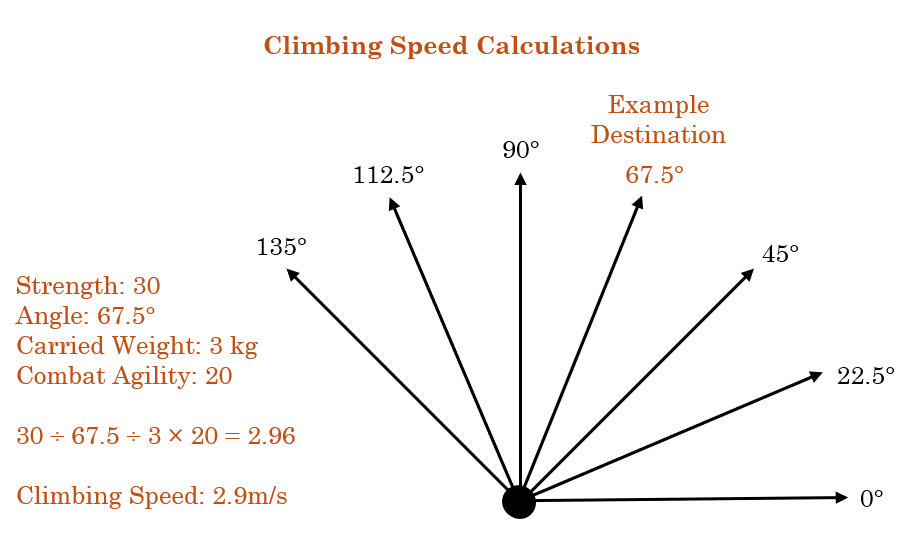
- 8.2.4. Climbing: Vertical movement available while next to a climbable object or structure. Speed is meters per second, calculated as Strength divided by angle divided by Character Carried Weight multiplied by Combat Agility, result floored to tenth.
- 9. Reaction: Can only be used as a response during another Creature's Turn, immediately after the Creature's declaration of an Action, prior to the start of Calculations. Only one Reaction from each player is allowed against each Action, and must meet Skill Requirements and Mechanics in order to be successful. If a defending Character cannot perceive the Action during Combat, they will be denied the opportunity to use a Reaction.
9.1. Reaction Types
- 9.1.1. Evade Reaction: May be used to avoid an oncoming physical attack, a projectile, or an area-of-effect. To succeed against areas-of-effect, Characters must physically move at their fastest available Movement Speed within the Duration Requirement of the Skill being avoided. Evasion fails if they cannot exit the Effect Zone.
- 9.1.2. Shield Reaction: May be used to block an oncoming physical attack or projectile, taking into account any directional trajectories.
- 9.1.3. Defense Reaction: May be used to empower oneself and mitigate damage of any oncoming attack.
- 9.1.4. Support Reaction: May be used to empower or weaken another Creature, an oncoming attack, or defense.
- 9.1.5. Intercept Reaction: May be used to stay within or physically move into the trajectory of an attack targeting another Creature, allowing the user to be the new Target. This Reaction may be done with Movement Actions.
- 10. Counterreaction: Can only be used as a response after the Calculations are completed for another Creature's Reaction.
- 11. Flavor: Can be stacked on any Action Type, including other Flavor Actions.
Combat Order
Combat Order is decided by Character Courage Scores arranged in Descending Order.
In case of equal values, tied Characters must roll their Courage Scores against each other, and their segmented order will be determined by arranging the roll results in a Descending Order.
Skills
Skills are Abilities, Techniques, or Spells that can be learned by Characters. All Skills cost Resource Points, and demand varying Scores, Durations, Items, and other Requirements to be studied, acquired, and performed. Skills will always specify Reach, Targeting, Effect Zones, Boosts, Hindrances, and/or Damage.
Swing your sword in the motion of circling winds, cutting a Single Target in Melee Distance.
Deal 6 Slashing Damage per 10 Combat Agility.
Usage Requirements:
- Discard 1 Energy Point
- Duration: 2 Seconds
- Action Type: Rooting
- Weapon: Sword
The Skill: Moulinet requires 1 Energy Point, at least 10 Combat Agility, 2 Seconds, a Sword, and is a Rooting action, which prohibits stacking of One-Armed, Two-Armed, Movement, and Whole Bodied actions. It will hit one specified Creature in Melee Distance, and deal 6 Slashing Damage for every 10 Counts of the Character’s Combat Agility Score.
Actions generally have guaranteed success, but guarantees can be removed when:
- A Reaction is announced by another Character to affect the result.
- A Skill Description specifically adds Randomization, Eligibility, or Failure Mechanics.
- A relevant Status or Effect Zone is in play.
Acquisition
To successfully acquire a new Skill, a Character must meet its Acquisition Requirements, which are visible only to The Game Master by default. Acquisition Requirements typically include minimum Score thresholds, prerequisite Skills, specific Actions that must be performed, or combinations thereof. A Character who attempts to learn a Skill without meeting all Requirements will fail to acquire it.
Characters can initiate acquisition through three methods:
-
1. Imitation: Copying another Character performing a Skill. The observing Character must meet the Skill’s Appraisal Requirements in order to be able to study it.
- A Character must be able to see and hear in order to imitate Whole Bodied Actions.
- A Character must be able to see or hear in order to imitate Rooting, Two-Armed, One-Armed, Psychic, and Movement Actions.
- A Character must be able to hear in order to imitate Vocal Actions.
- 2. Training Materials: Using instructional resources such as scrolls, tomes, or tutors that teach a Skill.
-
3. Organic Learning: Discovering a Skill naturally through combinations of Flavor Skills with each other, or with existing Skills during play.
- Flavor Skills: Foundational Actions that serve as building blocks for learning more advanced Skills. They are acquired differently from other Action Types.
Domain Flavor Skills
Acquired by studying or understanding their respective domain.
- Wisp
- Warmth
- Spray
- Fortify
- Coolth
- Glow
- Obscure
- Nourish
- Overgrow
- Prime
- Impulse
- Bedazzle
- Gild
- Decay
Weapon Flavor Skills
Acquired by wielding their relevant weapons.
- Sword Wield
- Archery
- Dagger Grip
- Axe Heave
- Hammer Haul
Reach
Skill Reach is the maximum distance at which Skills can affect their Casualties, as specified in Skill Descriptions. These are measured in meters and begin from the edges of Character Tokens, despite being referred to as radii.
- 1. Melee Distance: By default a 2-meter radius, but can be altered by Skills and Status Effects that specifically augment Melee Distance. Attempting a Melee Action to reach a target outside of this radius will result in an Immediate Miss, unless otherwise stated in the Skill Description.
- 2. Ranged Distance: Equal to a Character’s Accuracy in meters, capped by their Sight or Hearing, whichever is higher.
- 3. Perception Distance: Equal to the highest between a Character’s Sight, Hearing, Scent, and Aura. Taste does not contribute to Perception Distance.
- 4. Casting Distance: Equal to a Character's Magic in meters, capped by their best Perception.
Targeting
Skills determine how many Creatures or what areas are affected by Actions.
-
Targeting Types:
- 1. Self: The Skill affects only the user.
- 2. Single: The Skill affects one specified Casualty.
- 3. Multiple: The Skill affects a specified number of valid Casualties.
- 4. All: The Skill affects all valid Casualties.
- 5. Area of Effect: The Skill affects all valid Casualties within a defined zone.
Casualties
Skills determine what Casualties are affected by Actions.
Unless otherwise stated in Skill or Status Descriptions, friendly fire is true and self harm is false.
-
Casualty Types:
- 1. Self: The Character using the Skill.
- 2. Enemy: Another Character that is regarded as hostile.
- 3. Ally: Another Character that is regarded as amicable.
- 4. Target: Another Character that is specified.
- 5. Creature: Another Character, regardless of faction or specification.
Delivery
Skills come in various physical, magical, and metaphysical forms, and can be augmented by how Characters use and respond to them during play.
-
Delivery Types:
- 1. Immediate: Physical attacks made without crossing a distance, typically with Weapons within Melee Distance. These cannot be Intercepted.
-
2. Projectiles: Physical or magical attacks that travel a distance, typically from the User to a Target.
- Lateral: A projectile traveling in a straight line parallel to the ground. These can be Blocked, Evaded, or Intercepted at any point in their trajectory. Projectiles are Lateral by default, unless suggested otherwise by Skill Descriptions.
- Parabolic: A projectile traveling in an arc, rising then descending. These can only be Blocked by a roofed wall, and cannot be Intercepted.
- Falling: A projectile descending vertically. These can only be Blocked by a roof, and cannot be Intercepted.
- 3. Emissions: Magical or spiritual attacks that travel or emanate from a source towards or upon an Effect Zone. These cannot be Intercepted or Blocked.
- 4. Light Rays: Magical or spiritual attacks that travel or emanate from a source towards or upon an Effect Zone. These can be Intercepted or Blocked.
- 5. Manifestations: Magical or spiritual attacks that appear upon a Target or Effect Zone without traveling a distance. These cannot be Blocked or Intercepted.
- 6. Hex: Magical or spiritual attacks that affect a Target without traveling a distance. These cannot be Evaded, and can only be Blocked or Intercepted if the Target needs to be perceived.
Offensive Skills
Generally, Offensive Skills deal one instance of the total Damage, Exhaustion, Depletion, and Focus Loss, against each Casualty, unless otherwise stated by the Skill Description.
The total Damage value prior to applying any defensive calculations is referred to as Raw Damage, and includes the Base Damage/s of a Skill, modified by Scores and Status Effects. Raw Damage is first reduced by Mitigations from any Support Skills, producing Unmitigated Damage. Unmitigated Damage is then matched against Blocks, and finally reduced by Damage Reduction and Resistances after Irresistances.
What remains is the Final Damage dealt to Health Points.
Below are the possible Damage Types and their respective Reductions and Resistances:
- Aureal -> Aureal Resistance, Damage Reduction
- Bludgeoning -> Bludgeoning Resistance, Damage Reduction
- Cold -> Cold Resistance, Damage Reduction
- Drowning -> Drowning Immunity
- Fracturing -> Fracturing Resistance, Damage Reduction
- Heat -> Heat Resistance, Damage Reduction
- Light -> Light Resistance
- Magic -> Magic Resistance, Damage Reduction
- Piercing -> Piercing Resistance, Damage Reduction
- Poison -> Poison Resistance
- Shock -> Shock Resistance, Damage Reduction
- Slashing -> Slashing Resistance, Damage Reduction
- Spiritual -> Spiritual Resistance, Damage Reduction
- Suffocation -> Suffocation Immunity
- Umbral -> Umbral Resistance
Below are additional effects that are not Damage, and cannot be Blocked by Damage Reduction or Resistances:
- Depletion: Reduces Mana Points
- Exhaustion: Reduces Energy Points
- Focus Loss: Reduces Focus Points
Defensive and Support Skills
-
1. Evasion: Allows Characters to avoid Damage entirely by dodging oncoming attacks delivered as Immediate, Projectiles, Emissions, Light Rays, or Manifestations.
- To succeed against Area of Effect, Characters must physically move at their fastest available Movement Speed within the Duration Requirement of the Skill being avoided. Evasion fails if they cannot exit the Effect Zone.
-
2. Blocking: Allows Characters to use a shield or object to avoid Damage entirely against attacks delivered as Immediate, Projectiles, Light Rays, or Hexes.
- Blocking Skills specify the amount of Damage that Shields can take. If oncoming Damage exceeds Damage Block, Shield breaks and Damage is received and calculated as normal, and Inflicted Status Effects will also apply as normal, unless otherwise specified by Skill Description.
- If Damage Block exceeds oncoming Damage, Blocking succeeds and the excess is referred to as Surplus Block, which can be used for subsequent calculations if relevant.
- 3. Hindrance: Allows Characters to decrease Damage by temporarily altering the Scores of an Attacker.
- 4. Boost: Allows Characters to decrease Damage by temporarily altering the Scores, Damage Reduction, Resistances, and Irresistances of a Casualty.
- 5. Interception: Allows Characters to stay within or physically move into the trajectory of oncoming attacks delivered as Projectiles, Light Rays, or Hexes.
Statuses and Effects Zones
Statuses are temporary or persistent conditions attached to Creatures, which modify their Scores, Damage, and Protections, and impose restrictions or trigger effects.
They specify:
- Effects: What the Status does, which could include hindering Scores, raising Base Damage, allowing or disallowing specific Movement Types, etc..
-
Duration Types
- Timed: Lasts for Seconds ticking down only during the Inflicted Character's turns, not during any other’s.
- Indefinite: Lasts forever, without a timer, or without a cure.
- Until addressed: Lasts until fixed or diminished.
-
Stacking Types
- Refreshing: If a Status is applied to a Target that already has the same Status, the Duration is simply refreshed. Statuses are Refreshing by default, unless suggested otherwise by Status Descriptions.
- Replacing: If a Status is applied to a Target that already has the same Status, only the Infliction with better Potency stays.
- Stackable: Multiple instances can accumulate.
- Anchors: The Characters whose Scores determines the Status Potency or Duration
Effect Zones are areas affected by temporary or persistent conditions that change how Creatures are affected while within.
These tick down like Statuses, though during the Caster's turn only, unless the Skill Description specifies otherwise.
Summoning Skills
Summons are Creatures called into existence or presence via Summoning Skills. They have their own Character Scores, Inventory, and Skills.
-
Summon Types:
- 1. Animal - Creatures of wild nature, typically unable to speak.
- 2. Soul - Sapient creatures of spiritual nature, and have previously been alive.
- 3. Unrighteous - Sapient creatures that have gained near immortality at the expense of their soul.
- 4. Divine - Sapient creatures of holy nature, no longer alive but gifted eternal existence by heavenly favour.
A Summoned Entity is placed immediately after the Summoner in the Combat Order and has its own Turn.
Attempting to Summon a Soul, Unrighteous, or Divine who is already present consumes the Skill's Usage Requirements, but the entity may not be summoned twice.
There is no limit to the number of Summons that can be called at once.
Summon will remain until defeated.
A Soul, Unrighteous, or Divine who has been defeated cannot be Summoned by the same Summoner again until after Resting.
An Animal whose Health Points fall to 0 will meet death, as any Character would.
Declarations and Action Processing
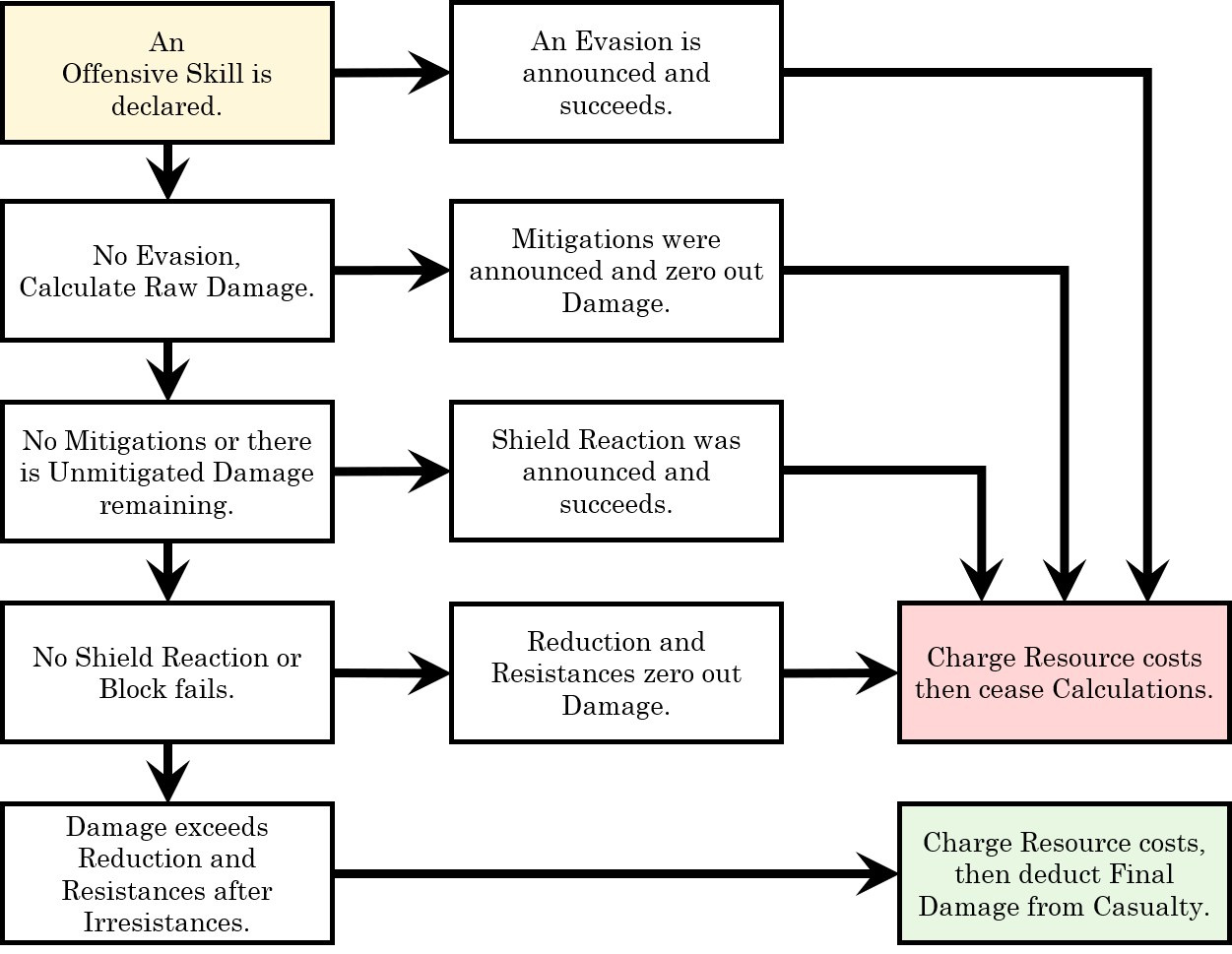
During Combat, Actions are processed in the following order:
- 1. An Offensive Skill is declared.
- 2. Reactions, if any, must be announced.
- 3. If no Evasion or Evasion fails, calculate Raw Damage.
- 4. If any Mitigations, calculate Unmitigated Damage.
- 5. If no Block or Block fails, deduct Damage Reduction and Resistances after Irresistances.
- 6. Deduct Final Damage from Health Points.
Damage Calculations
All Damage Types, except Drowning, Light, Poison, Suffocation, and Umbral Damage, are canceled out by Damage Reduction, and all except Drowning and Suffocation are canceled out by their corresponding Resistances, one-for-one.
For example:
- 5 Slashing Damage against 3 Damage Reduction will result in 2 Slashing Damage
- 5 Cold Damage against 1 Cold Resistance will result in 4 Cold Damage
- 5 Heat Damage against 3 Damage Reduction and 1 Heat Resistance will result in 1 Heat Damage
- 5 Light Damage against 2 Damage Reduction will result in 5 Light Damage
- 5 Shock Damage against 3 Damage Reduction and 2 Magic Resistance will result in 2 Shock Damage
In case of multiple Damage Types within an instance of a Skill’s Raw Damage, general Damage Reduction will always deduct from Damage Types according to the order they are dictated during Damage Declaration, regardless if the Damage Type has a Corresponding Resistance in the receiving Opponent’s Defenses.
For example:
- 10 Cold Damage and 2 Heat Damage against 3 Damage Reduction and 4 Cold Resistance will result in 3 Cold Damage and 2 Heat Damage
- 2 Heat Damage and 10 Cold Damage against 3 Damage Reduction and 4 Cold Resistance will result in 5 Cold Damage
Success from Non-Combat
Success in Combat can be achieved through means other than defeating the enemy. In such scenarios, The Game Master, guided by the present Game Scores, will decide whether Combat can be exited or not.
Equipment
Armor
-
Head
- There is one slot to equip the head.
-
Neck
- There is one slot to equip the neck.
-
Torso
-
There are two routes for stacking Torso Equipment.
-
The Soft Route, which allows 3 Torso Slots:
- Layer 1: Shirt or Undergarments
- Layer 2: Vest or Corset (Corset Requires Layer 1)
- Layer 3: Coat or Robe or Dress
-
The Stiff Route, which allows 5 Torso Slots
- Layer 1: Shirt or Undergarments
- Layer 2: Cloth Armor
- Layer 3: Chainmail (Requires Stiff, Layer 2 Equipment)
- Layer 4: Plate Armor (Requires Stiff Layer 2 Equipment)
- Layer 5: Surcoat (Requires Stiff Layer 3 or Stiff Layer 4 Equipment)
-
The Soft Route, which allows 3 Torso Slots:
-
There are two routes for stacking Torso Equipment.
-
Shoulders
- Left and right can be equipped independently with pieces from different sets.
- Opting for the Soft Route under Torso Equipment without Layer 3 will allow the Character to wear Spaulders or Pauldrons.
- Opting for the Soft Route under Torso Equipment with Layer 3: Dress will allow the Character to wear Bishop Sleeves.
- Opting for the Stiff Route under Torso Equipment will allow the Character to wear Spaulders, Pauldrons, or Bishop Sleeves
-
Forearms
- Left and right can be equipped independently with pieces from different sets.
- Wearing Soft Equipment on Forearms will allow the wearability of Bracelets.
- Wearing Bracers and Vambraces will remove their corresponding Bracelet slot.
- Wearing a Kalkan Shield on one forearm while wielding a Bow and Arrow is permitted, but it will be counted as a Stiff Armor piece.
-
Legs
- Left and right must be equipped with pieces from the same set.
-
There are two routes for Leg Equipment
-
The Soft Route, which allows 4 Leg Slots:
- Layer 1: Stockings
- Layer 2: Breeches, Trousers, or Slacks
- Layer 3: Boots
- Accessory Slot: Belt
-
The Stiff Route, which allows 4 Leg Slots
- Layer 1: Leggings
- Layer 2: Sabatons
- Layer 3: Greaves (Requires Layer 2)
- Layer 4: Cuisses (Requires Layer 3)
-
The Soft Route, which allows 4 Leg Slots:
Weapons
Weapon Flavor Skills
Wielding a Weapon immediately initiates its corresponding Flavor Skill’s acquisition, if not acquired already.
- Sword -> Sword Wield
- Bow -> Archery
- Dagger -> Dagger Grip
- Axe -> Axe Heave
- Hammer-> Hammer Haul
Dual Wielding
A Character can wield two Melee Weapons at once as long as the Weapons’ combined Weight does not exceed a quarter of the wielder’s Strength. A weapon must be wielded with two hands if it weighs at least a quarter of the wielder’s Strength.
Discarded Weapons
Arrows and throwing daggers must be replenished by purchasing or crafting, but can be recovered after Combat as long as the quantities are tracked and locateable.
Equipment Switching
Switching Equipment during Combat, whether equipping, unequipping, or swapping Armor or Weapons, always takes 5 Seconds. Therefore, since a Turn is 5 Seconds long, switching Equipment consumes an entire Turn.
Equipment Defects and Repairs
The following Statuses reduce the Protection provided by Equipment:
- Bent
- Burnt
- Cracked
- Deformed
- Dismantled
- Marked
- Molten
- Pierced
- Shattered
- Tattered
- Torn
Equipment affected by these can be restored through two methods:
- 1. Armorer Services - Characters may visit an Armorer to have equipment defects fixed. The base cost is 10 Currency per stack of any Defect Status. Armorers can repair all Defect Status types, regardless of material.
- 2. Self-Repair - Characters with access to a Forging Hammer or Needle may repair Stiff and Soft Armor respectively, by spending 1 Energy Point and 1 Focus Point to remove each Defect Status stack.
Perception
Sight
The distance at which one can see clearly, directly affected by Light Levels and Vision Statuses. Opaque objects, structures, and other Creatures also obstruct vision.
Vision Statuses
Characters must start with one Vision Status. Exceptions may be awarded to races with vision advantages. Characters without any specified Vision Status are automatically awarded with Emmetropic.
Default Vision Statuses and their respective Resistances are the following:
- 1. Emmetropic = 4 Light Resistance, 4 Umbral Resistance
- 2. Void Seeker = 2 Umbral Resistance per 10 Magic
- 3. Night Vision = 5 Umbral Resistance, 1 Light Resistance
- 4. Diurnal = 5 Light Resistance, 2 Umbral Resistance
- 5. Light Seeker = 2 Light Resistance per 10 Aura.
A Character can forego Sight altogether by requesting the permanent Status: Blind. Blind Characters are unable to Imitate Whole Bodied Actions, or use Training Materials to acquire Skills.
Blind: You are unable to see.
Your Sight is permanently null. Your Hearing, Scent, and Aura are doubled during calculations.
You ignore Light and Umbral Damage.
Light Levels and Vision Status Effects
Creatures may see clearly within Sight Distance, as long as their Light and Umbral Resistances exceed the setting’s Inherent Light Level Damage.
-
The Light Level Scale and Inherent Light Level Damage are as follows:
- Light Level -I = Magical Darkness = 5 Umbral Damage
- Light Level 0 = Darkness = 4 Umbral Damage
- Light Level I = Moonlight = 3 Umbral Damage
- Light Level II = Candlelight = 2 Umbral Damage
- Light Level III = Torchlight = 1 Light Damage, 1 Umbral Damage
- Light Level IV = Room Lighting = 2 Light Damage
- Light Level V = Daylight = 3 Light Damage
- Light Level VI = Spotlight = 4 Light Damage
- Light Level VII = Blinding Lights = 5 Light Damage
- Light Level VIII = Whiteness = 6 Light Damage
- During their Turn, Creatures take damage per Duration Second spent in Light Levels exceeding their Light and Umbral Resistances.
Hearing
The distance at which one can hear. Hearing allows a Character to determine the direction of a sound, but not its location.
Scent
The distance at which one can smell. Smelling allows a Character to notice the presence of an object or Creature, but not their direction or location.
Aura
The distance at which one can sense spirits. Aura allows a Character to notice another Aura, but not its exact direction or location.
Socialization
Languages
Characters will be able to converse freely if they have at least one language in common, or if another Character within the party can act as an interpreter. There will be no need for actual repetition or interpretation during play, unless relevant in the moment.
- Interpreters may state at any point if they choose to withhold information during a conversation, or if they had simply stopped interpreting in the meantime. Other Characters must acknowledge this and respect the language barrier.
Conversations
Conversational successes will be decided by rolling the Social Scores of parties involved.
- If rolling a Character’s Charisma against a Listener’s Concession results in a success, the Listener will be persuaded. Otherwise, the Listener will be disapproving.
- If rolling a Character’s Deception against a Listener’s Judgement results in a success, the Listener will be deceived. Otherwise, the Listener will be distrustful.
- If rolling a Character’s Intimidation against a Listener’s Courage results in a success, the Listener will be wary. Otherwise, the Listener will ignore any threats.
Cumulative Efforts
- If a Party creates a cumulative effort for persuasion, deception, or intimidation, the Social Scores of the Party must be averaged and then rolled against the Listener’s Concession, Judgement, or Courage.
- If there are 2 - 5 Listeners, the Character or Party’s Social Scores must be checked against each Listener individually.
- In the case of an Audience with more than 5 members, the Listeners’ Scores will be that of the most prominent or charismatic member.
Adventuring
Recovery
Resource Points used can be restored, and some Statuses can be cured by taking breaks and consuming food within play.
- 1. Resting: Outside of Combat, a Party can choose to Rest. Every hour of Rest restores 5 Points to Health, Energy, Focus, and Mana.
- 2. Meals: Consuming a Meal may restore Resource Points and grant Experience Points towards specific Scores. The benefits depend on the Meal’s Consumption Boosts, often modified by the Consumer’s Taste Score.
Carrying Capacity
A Character’s maximum Carrying Capacity is equal to the Character’s Strength in kilograms, plus any special Carrying Capacity buffs from Status Effects.
- Equipped Armor and Weapons do not add to Carried Weight, but unequipped Armor and Weapons within the Inventory will.
Looting
Looting is the act of collecting Materials and Items from the world. These gathered Materials form the foundation for Trading, Crafting, and Cooking.
There are two types of Loot Sources:
1. Raw Sources: Animals, Plants, and other natural Sources where Items must be extracted directly.
• A Raw Source must be dead or otherwise accessible before Looting can be done.
• Each Raw Source has a finite amount of Collectable Items, specified by their Character Sheet or Setting Description, visible only to The Game Master by default. Once depleted, no further Items may be collected from that Raw Source.
• Characters must meet Collection Requirements to successfully extract Items from Raw Sources. These Requirements vary by Material and may include:
▪ Damage Requirements: Specific Damage Types and amounts that need to be dealt by using a Skill.
▪ Score Requirements: Minimum values for Scores needed to properly identify and extract the Item.
▪ Item Requirements: Certain Tools or Materials.
• When a single Skill meets or exceeds the combined Collection Requirements of multiple units of the same Material, the Character may Collect all such units with that single Skill use. Resource Point costs are paid once for the Skill, not per unit Collected.
2. Containers: Chests, bags, pouches, and other storage that hold Items already collected or stored by others. Items in Containers may simply be taken without the need to meet Collection Requirements. Characters need only be able to access the Container, and locks, traps, or guards must be considered.
Trading
Characters can exchange Items and Materials for Currency through Trading.
Every Material has a Sell Price, the base Currency value a merchant will pay for it.
A crafted Item’s Sell Price will be calculated from the totaled Sell Prices of the Materials used to create it.
Selling
To sell an Item, a Character must find a willing buyer. The buyer pays the Item’s Sell Price in Currency, and the Item transfers from the Character’s Inventory to the buyer.
Buying
To buy an Item, a Character must find a seller with the desired Item in stock. Buying Prices are set by the seller and may exceed the Item’s Sell Price. The Character pays the asking price in Currency, and the Item transfers to the Character’s Inventory.
Bartering
Characters may attempt to negotiate prices or trade Items directly without Currency. Bartering success is determined by rolling the Character’s Social Scores against the other party’s. The Game Master determines the outcome based on the roll result and the reasonableness of the offer.
Crafting, Cooking, and Brewing
Crafting, Cooking, and Brewing allow Characters to transform raw Materials into useful Items, Equipment, and Meals.
The process follows three stages:
- 1. Material Collection
- 2. Processing
- 3. Combination According to Recipe
Materials
Materials are the rawest form of Items, gathered through Looting. Each Material has basic properties, and one or more Material Scores that determine how it can be used in Crafting, Cooking, and Brewing.
Material Score Types
Material Scores indicate what role a Material can serve in a Recipe. The types are:
- 1. Adhesive: Binding agents.
-
2. Adornment: Decorative elements.
- Adornments are special Materials that can be added to any non-Meal Recipe without needing to be a Requirement.
- 3. Alchemical: Brewing ingredients.
- 4. Cloth: Woven fabrics.
- 5. Emulsifier: Blending agents.
- 6. Fermenter: Fermentation catalyst.
- 7. Fiber: Threadlike materials.
- 8. Frame: Structural components.
- 9. Fruit: Edible plant products.
- 10. Fungi: Mushrooms or yeast.
- 11. Glass: Transparent, fragile materials.
- 12. Herb: Edible greens.
- 13. Leather: Elastic, bendable hide.
- 14. Liquid: Potable juices or water.
- 15. Lumber: Wood.
- 16. Meat: Edible flesh.
- 17. Metal: Solid, malleable, and lustrous substances.
- 18. Oil: Viscous, hydrophobic fluids.
- 19. Plume: Feathers and down.
- 20. Powder: Fine or ground substances.
- 21. Seasoning: Flavor enhancers.
- 22. Soil: Loose or compacted earth.
- 23. Starch: Carbohydrates.
- 24. Stone: Solid minerals.
Bonus Values
Materials provide unique Bonuses when used in Recipes. The Bonus Type depends on the role the Material is filling upon creation, as well as what is being created:
- Armor Boost Bonus: Added to crafted Armor.
- Weapon Boost Bonus: Added to crafted Weapons.
- Score Boost Bonus: Added to any crafted Item that can be equipped.
- Durability Bonus: Added to Items that deteriorate, and with Durability as specified by Recipes.
- Consumption Boost Bonus: Added to cooked Meals and brewed Brews.
Bonus Values typically scale with a Crafter’s relevant Score (Crafts, Cooking, or Medicine). For example, “1 Damage Reduction per 100 Crafts” means a Character with 150 Crafts creates the Armor with 1 Damage Reduction, and “1 Max Health per 10 Cooking, per 10 Consumer Taste” means a Character with 20 Cooking can make a Meal that adds 2 Max Health per 10 Taste.
On top of Bonus Values, Materials also proportionally contribute to the Weights and Sell Prices of their Output Items.
Processing
Before a Material can contribute its Score to a Recipe, it must be Processed. Processing transforms raw Materials into usable components by meeting Processing Requirements.
Processing Requirements may include:
1. Resource Point Costs: Energy, Focus, or Mana Points to be spent.
2. Damage Requirements: Damage that must be dealt to the Material using a Skill.
3. Item Requirements: Tools, Weapons, or other Items required.
4. Material Requirements: Other processed Materials.
5. Commission: Currency paid, only relevant if using Non-Player Characters to Craft or Cook on a Character’s behalf.
Materials may offer multiple processing paths, indicated by “Or”. Characters choose any path for which they meet all Requirements.
Example:
To process a Rat Fur as a Cloth Material, a Character may meet any of the following Processing Requirements:
Processing Requirements:
• Fiber: 0.2
• Item: Needle
• 1 Focus Point
Or
• Currency (as Commission): 2
When a single Skill meets or exceeds the combined Processing Requirements of multiple units of the same Material, the Character may Process all such units with that single Skill use. Resource Point costs are paid once for the Skill, not per unit Processed.
Recipes
A Recipe is a blueprint for creating an Item, piece of Equipment, or Meal. Characters must own a Recipe to create its Output. Recipes specify Material Requirements, the minimum Material Score values needed.
Example:
Recipe: Needle
A slender piece with a fine point at one end and an eye for thread at the other, used in sewing.
Quantity: 1
Weight: 0.0 kg
Sell Price: 0 Currency
Durability: 0/0
Materials Used:
•
Material Requirements:
• Frame: 0/20
Or
• Metal: 0/5
The Needle Recipe requires 20 Frame or 5 Metal.
A Character could satisfy this with 40 Rat Bones, each providing 0.5 Frame, totaling 20 Frame, or find a Metal source providing at least 5 Metal.
Materials can exceed requirements, and each excess will still contribute its Values, except Weight. From a canonical sense, Crafters and Cooks are simply able to create better, more effective components with additional attempts and materials to use.
Adornment Materials are special as they can be added to any non-Meal Recipes regardless of being a Requirement or not, as they are merely used for decorative customization.
Crafting
Crafting combines processed Materials according to a Recipe to create Items, Armor, or Weapons. The crafter's Crafts Score determines the Bonus Values applied.
Crafting Process
- 1. Select an owned Recipe.
- 2. Gather Materials to meet or exceed the Recipe's Material Requirements.
- 3. Process each Material by spending Resource Points, meet Damage Requirements, Item Requirements, and others.
- 4. Calculate Bonus Values from all processed Materials based on Crafts Score.
- 5. Apply Bonus Values, Weight, and Sell Price to the Recipe's placeholders.
- 6. Name the Item and add it to Inventory.
- 7. Reset the Recipe for future use.
Crafting can be paused if Resources or Materials are lacking. Game masters must note the progress under the Recipe so it can easily be resumed later.
Cooking and Brewing
Cooking and Brewing follow the same process as Crafting, but use the Cooking Score or Medicine Score instead of Crafts, and produce Meals or Brews instead of Equipment and regular Items. Meals and Brews grant Consumption Boosts, which are permanent benefits granted when consumed.
Optional Ingredients
Similar to Adornments in Crafting, Emulsifiers, Fruits, Herbs, Liquids, Meats, Seasonings, and Starches may be added to Meal Recipes regardless of whether the recipe originally required them or not, as long as the true Requirements are met.
Consumption Boosts
Consumption Boost magnitudes may depend on both the Cook’s Cooking Score or Brewer’s Medicine Score, and the Consumer’s Taste Score.
Example:
Recipe: Soup
A simple broth made by boiling ingredients.
Quantity: 1
Weight: 0.0 kg
Sell Price: 0 Currency
Consumption Boost:
• (Ex. +1 Poison Resistance per 10 Taste)
Material Used:
• (Ex. Rat Meat)
Material Requirements:
• Herb: 0/100
• Liquid: 0/250
Or
• Liquid: 0/250
• Meat: 0/100
Item: Rat Meat
A small portion of stringy flesh carved from a rodent.
Quantity: 1
Weight: 0.02 kg
Sell Price: 1 Currency
Material Scores: Meat
Material Scores:
As Meat: 20
Consumption Boost Bonus:
• Restore 1 Health Point per 10 Cooking, per 20 Consumer Taste
Processing Requirements:
• Heat Damage: 3
• Energy Points: 1
A Character with 40 Cooking wants to make Soup using Rat Meat.
The Recipe Requirements are 250 Liquid and 100 Meat. Since Rat Meat has a Meat Score of 20, the Character only needs 5 Rat Meat to achieve the 100 Meat Requirement.
Each Rat Meat must be processed with 3 Fire Damage and an Energy Point.
Once processed, each Rat Meat contributes its Consumption Boost Bonus, which is to “Restore 1 Health Point per 10 Cooking, per 20 Consumer Taste.” With 40 Cooking, each unit provides 4 Health Points. Five units total 20 Health Points base, which means a whole Soup restores 20 Health Points per 20 Taste.
• A Consumer with 20 Taste restores 20 Health Points.
• A Consumer with 60 Taste restores 60 Health Points.
• A Consumer with only 10 Taste restores no Health Points.
Crafting, Cooking, and Brewing Tools
Certain Items function as Crafting, Cooking, and Brewing Tools, required for specific Processing Operations. These Tools have Durability that decrease by 1 after each use, whether it be to process Materials or to use Recipes. When Durability reaches 0, the Tool breaks and must be purchased or created again.
Commissions
Players may choose to enlist the assistance of Crafting NPCs in order to perform Crafting, Cooking, or Brewing on their behalf. The Cost of Services may be calculated by summing all Commissioning Costs of Materials used, multiplied by the floored tenth of the relevant Character Score required (Cooking, Crafts, Medicine, etc.).
Glossary
Action - Anything done during a Turn, or against another Action during another Creature’s Turn.
Accuracy - Measure of one’s precision.
Acquisition Requirements - The Score thresholds, prerequisite Skills, and Actions a Character must meet to learn a new Skill.
Ally - Creature who is regarded as friendly.
Anchor - The Character whose Scores determine a Status's Potency or Duration.
Animal - A Creature of Fauna Class.
Appraisal - The act of identifying or evaluating a Material, Item, Creature, or Skill. Appraisal Requirements specify Scores needed to succeed.
Appraisal Requirements - Score thresholds a Character must meet to study and identify a Skill, Material, Item, or Creature.
Armor - Equipment worn on the body that provides Damage Reduction, Resistances, and other protective benefits.
Audience - A group of more than 5 Listeners, whose collective Social Scores are represented by the most prominent or charismatic member.
Aura - Measure of one’s spiritual affinity.
Bartering - The act of negotiating prices or trading Items directly without Currency.
Base Damage - The unmodified Damage value of a Skill before applying Score multipliers and Status Effects.
Beast - Measure of one’s knowledge of animals, as well as their understanding of self.
Blind - A permanent Status that renders a Character unable to see, but boosts other Scores, and gives Light and Umbral Damage immunity.
Block - Shield from Unmitigated Damage of an Offensive Action.
Bonus Value - A benefit provided by a Material when used in a Recipe, scaling with the user’s Crafts, Cooking, or Medicine Score.
Boost - Temporarily increase another Creature’s Score.
Brew - A consumable Item created through Brewing that grants Consumption Boosts when drunk.
Brewing - The process of combining processed Materials according to a Recipe to create Brews.
Buying Price - The Currency amount a seller charges for an Item. Frequently exceeds an Item’s Sell Price.
Calculations - The process of determining an Action’s effect values.
Cancel - Prevent all Damage and Effects of another Creature’s Action.
Carried Weight - The total Weight of all Items currently in a Character’s Inventory.
Carrying Capacity - The maximum Weight a Character can hold in their Inventory, equal to Strength in kilograms plus any Status buffs.
Casting Distance - The maximum distance at which a Character can use magical Skills, equal to Magic in meters, capped by their highest Perception Score.
Casualty - Creature affected by Skill Damage, Boosts, or Hindrances.
Character - Primary Creature piloted by a Player.
Charisma - Measure of one’s likeability.
Climbing Speed - Vertical movement speed while next to a climbable surface, calculated as Strength ÷ angle ÷ Carried Weight × Combat Agility, floored to the tenth.
Collection Requirements - The Damage, Score, and Item Requirements that must be met to extract Materials from a Raw Source.
Combat Agility - Measure of one’s quickness to change the position of their body.
Combat Order - The order that Creatures take Turns during Combat. Decided by Creature Courage Scores arranged in a Descending Order.
Commission - Currency paid to a Non-Player Character to Process, Craft, or Cook on a Character's behalf.
Concession - Measure of one’s impartiality.
Construct - A Creature of Mechanical Class.
Consumer - A Character who eats a Meal to receive its Consumption Boosts.
Consumption Boost - A permanent benefit granted when a Meal is consumed. Magnitudes often scale with Cooking Score and Consumer Taste.
Container - A storage object such as a chest, bag, or pouch from which Items may be taken without the need to meet Collection Requirements.
Cooking - The process of combining processed Materials according to a Recipe to create Meals, or the Measure of one’s ability to cook
Counterreaction - An Action that may only be declared after another Creature’s Reaction, immediately after the Creature’s Calculations are completed.
Courage - Measure of one’s mental tenacity. Dictates the arrangement of Turns in the Combat Order.
Crafting - The process of combining processed Materials according to a Recipe to create Items, Armor, or Weapons.
Crafts - Measure of one’s ability to create.
Creature - Any entity with any Resource Points.
Currency - The game’s medium of exchange, which sometimes acts as a fifth Resource Point or another Score in Skills or Statuses.
Damage - A reduction to Health Points.
Damage Reduction - Reduction to all Damage Types except Drowning, Poison, Light, Suffocation, and Umbral Damage.
Dancing - Measure of one’s ability to dance.
Deal - Deduct from another Creature’s Resource Points.
Deception - Measure of one’s cunningness.
Defect Status - A Status that reduces the Protection provided by Equipment.
Defense Reaction - A Reaction used to empower oneself and Mitigate Damage from an oncoming attack.
Delivery - Measure of one’s ability to speak in public.
Depletion - A reduction to Mana Points.
Diminish - Reduce Duration Seconds of a Status.
Divine - A Creature of Heavenly Class.
Durability - A numerical value representing how many uses remain before a Tool becomes unusable.
Duration Seconds - The time it takes to perform an Action, regardless of how long its effect will last.
Effect Zone - An area affected by temporary or persistent conditions that modify how Creatures are affected while within.
Emission - A magical or spiritual attack that travels or emanates from a source toward an Effect Zone. Cannot be Intercepted or Blocked.
Enemy - Creature who is regarded as hostile.
Energy Point - Available, spendable Energy.
Equipment - Armor and Weapons that can be equipped by a Character.
Evade Reaction - A Reaction against an Offensive Action, performed through a Movement Action outside of turn.
Exhaustion - A reduction to Energy Points.
Experience Points - Points earned through training, victories, or Game Master awards, invested to raise Character Scores.
Final Damage - The Damage remaining after all Protections are applied, deducted directly from Health Points.
Flavor Skill - A foundational Action that serves as a building block for learning more advanced Skills.
Flight Speed - Multidirectional movement speed available to Creatures with appropriate Status or Biological Requirements.
Focus Loss - A reduction to Focus Points.
Focus Point - Available, spendable Focus.
Friendly Fire - The default rule that a Skill can affect Allies, unless stated otherwise.
Gain - Temporarily increase your own Score and/or Resistances, or temporarily tie a Status to yourself.
Health Point - Available, spendable Health.
Hearing - The distance in which a Creature can hear.
Herbalism - Measure of one’s knowledge of plants.
Hex - A magical or spiritual attack affecting a Target without traveling. Cannot be Evaded; can only be Blocked or Intercepted if the Target must be perceived.
Hinder - Temporarily decrease another Creature’s Score.
History - Measure of one’s knowledge of the past.
Ignore - Reduce Casualty's Scores during Checks and Calculations.
Immediate Miss - Automatic failure of a Skill.
Inflict - Tie a Status to another Creature.
Infliction - An instance of a Status being applied to a Creature.
Inflictor - The source of a Status.
Inherent Light Damage - Light Damage dealt by area or target’s location based on its Inherent Light Level.
Inherent Light Level - The luminance of a location.
Inherent Light Level Damage - Light and Umbral Damage taken per Duration Second spent in a location.
Inherent Umbral Damage - Umbral Damage dealt by area or target’s location based on its Inherent Light Level.
Instance - A set of Damage, Hindrance, or Boost Calculations per Target. All Skills deal one Instance against each Creature allowed by the Skill’s Targeting Mechanics, unless otherwise stated.
Instrumental - Measure of one’s ability to play musical instruments.
Intercept Reaction - A Reaction used to stay or move into the trajectory of a projectile targeting another Casualty, allowing the user to become the Target.
Intimidation - Measure of the pressure from one’s presence.
Irresistance - Reduction to its respective Resistance Type.
Inventory - The collection of Items, Materials, and Equipment carried by a Character.
Item - Any object that can be carried, used, traded, or equipped.
Judgement - Measure of one’s recognition of truth.
Light Level - A scale measuring the luminance of a location, ranging from Magical Darkness (-I) to Whiteness (VIII), determining Inherent Light and Umbral Damage.
Looting - The act of collecting Materials and Items from Raw Sources or Containers.
Lose - Temporarily decrease your own Score, or remove a Status from yourself.
Magic - Measure of one’s knowledge of the arcane.
Mana Point - Available, spendable Mana.
Material - A raw or processed component used in Crafting and Cooking.
Material Requirements - The minimum Material Score values a Recipe demands to create its output.
Material Score - A value indicating how much of a specific Material Score Type a Material provides when used in a Recipe.
Max Energy - The limit to Energy Points at full recovery. Can be increased by investing Experience Points.
Max Focus - The limit to Focus Points at full recovery. Can be increased by investing Experience Points.
Max Health - The limit to Health Points at full recovery. Can be increased by investing Experience Points.
Max Mana - The limit to Mana Points at full recovery. Can be increased by investing Experience Points.
Meal - A consumable Item created through Cooking that grants Consumption Boosts when eaten.
Medicine - Measure of one’s knowledge of health and brewing.
Melee Distance - The maximum distance for Melee Actions, 2 meters from the edge of Character Tokens by default.
Mitigation - Reduction to Damage prior to Block and Health Reduction Calculations of an Offensive Action.
Mortuary - List of Souls tied to a Creature.
Non-Player Character - A Creature controlled by the Game Master rather than a Player.
Offensive Action - A Skill that reduces another Creature’s Resource Points.
Pack - List of Animals tied to a Creature.
Party - A group of Characters traveling or acting together.
Perception Distance - The maximum distance at which a Character can perceive, equal to their highest Perception Score.
Plant - A Creature of Flora Class.
Player - A participant who controls a Character.
Processing - The act of transforming a raw Material into a usable component by meeting Processing Requirements.
Projectile - A physical or magical attack that travels a distance from User to Target.
Protection - Mitigation, Blocks, Damage Reduction, and Resistances, prior to deduction from Health Points.
Ranged Distance - The maximum distance for ranged attacks, equal to Accuracy in meters, capped by Sight or Hearing.
Raw Damage - An Offensive Skill’s Damage Value prior to Mitigations.
Raw Source - A Creature, Plant, or natural source from which Materials must be extracted by meeting Collection Requirements.
Reaction - An Action that may only be declared during another Creature’s Turn, immediately after the Creature’s announcement of their Action, but prior to Damage Calculations being begun.
Recipe - A blueprint specifying the Requirements needed to create an Item, Equipment, or Meal.
Recover - Add to your own Resource Points.
Resistance - Reduction to its respective Damage Type.
Resource Point - Available, spendable Energy, Focus, Health, or Mana.
Resting - An out-of-Combat activity that restores 5 Points to Health, Energy, Focus, and Mana per hour.
Restore - Add to another creature’s Resource Points.
Retry - Use an Evaded Action against the same Target/s without spending the costs again.
Sanctuary - List of Divines tied to a Creature.
Scent - The distance in which a Creature can smell.
Score - A numerical value representing a measurable aspect of a Character's capabilities.
Sell Price - The base Currency value a merchant will pay for a Material or Item.
Shield Reaction - A Reaction against an Offensive Action, performed through a Skill to Block Damage.
Sight - The distance in which a Creature can see.
Singing - Measure of one’s ability to sing.
Soft Route - An armor layering path allowing lighter, more flexible equipment with fewer slots.
Soul - A Creature of Spiritual Class.
Status - Temporary or permanent modifications tied to a specific Creature’s Scores, Skills, and Conditions.
Stiff Route - An armor layering path allowing heavier, rigid armor with more layering slots.
Strength - Measure of one’s physical power.
Suffer - Temporary decrease your own Resistances, or temporarily tie a Status to yourself.
Summon - A Creature called into existence or presence via a Summoning Skill.
Support Reaction - A Reaction against another Creature’s Action, performed to Boost or Hinder Scores.
Surplus Block - Any remaining Block after Blocked Damage Calculations.
Swimming Speed - Multidirectional movement speed while fully submerged in water.
Take - Deduct from your own Resource Points.
Target - Specified Creature.
Taste - Measure of one’s ability to absorb nutrition.
Token - The physical or visual representation of a Character's position on the play area.
Tool - An Item required for specific Processing, Crafting, or Cooking operations. Has Durability.
Torment - List of Unrighteous tied to a Creature.
Trading - The exchange of Items and Materials for Currency or other Items.
Training Materials - Instructional resources such as scrolls, tomes, or tutors used to learn Skills.
Turn - A Character’s opportunity to perform Actions during Combat Order. Mechanically, a Turn is always 5 Duration Seconds long.
Unmitigated Damage - Raw Damage minus Mitigations, before Blocks, Damage Reduction, and Resistances.
Unrighteous - A Creature of Hellish Class.
Vision Status - A permanent Status that defines how a Character's eyes process light, granting Light and Umbral Resistances.
Weapon - Equipment wielded to perform offensive Skills.
Weight - The mass of an Item or Material in kilograms, which contributes to Carried Weight while in Inventory.